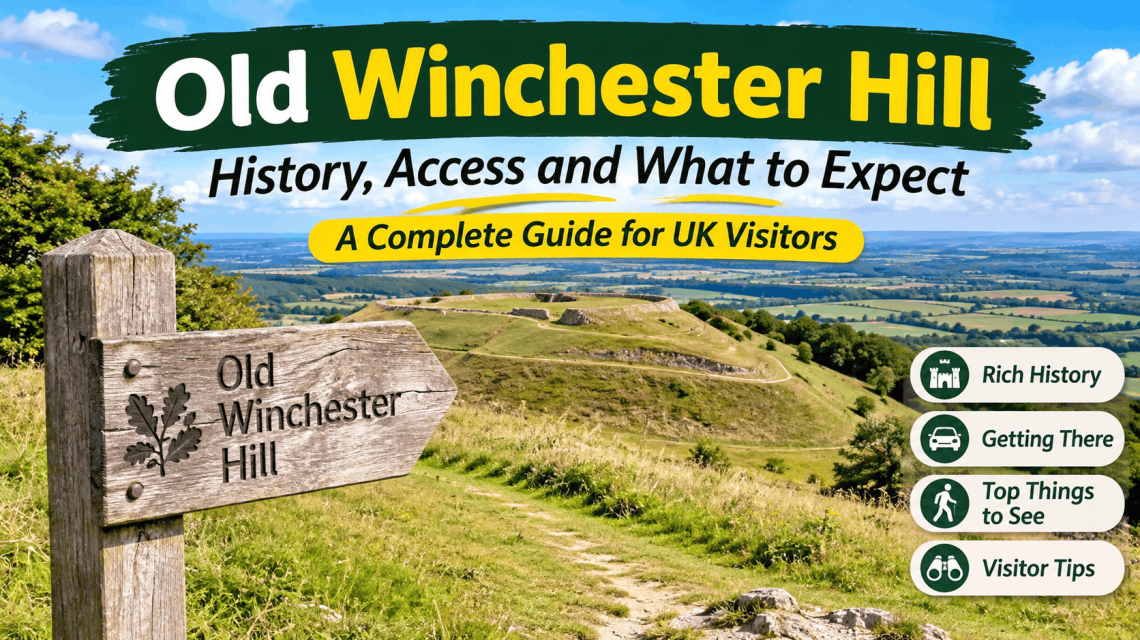
Old Winchester Hill is one of those places where the name tells you almost nothing useful. It sits about eleven miles from Winchester, yet it carries the city’s name. It is a hill fort, a nature reserve, and a working piece of chalk downland all at once, and it happens to sit on one of the most walked long-distance paths in southern England. If you are planning a visit, or you simply want to understand what is there and why it matters, this guide covers where it is, how it came to be protected, and what you should know before you go.
Where is Old Winchester Hill?
Old Winchester Hill lies in Hampshire, on the eastern side of the Meon Valley, roughly between the A3 and the A32 . Despite the name, it is around 11 miles (18 km) from Winchester itself, though it forms part of the same geological structure, the Winchester–East Meon Anticline . The nearest villages are Corhampton and Warnford, and the nearest town of any size is Petersfield, about 10 km to the east .
The hill reaches 197 metres (646 feet) above sea level, which gives it commanding views across the Meon Valley and the surrounding downland . It became part of the South Downs National Park in March 2009 . The South Downs Way and the Monarch’s Way both cross the summit, which means the hill is accessible on foot from a number of directions and is a natural stopping point for long-distance walkers .
For anyone arriving by car, the main car park is at the northern end of the reserve, with access to a picnic area and an interpretation unit . There is also a smaller parking area for disabled visitors at the viewpoint along Old Winchester Hill Lane, and RADAR key holders can use a separate car park from the north gate to follow an Easy Access Trail to the hill fort . Public transport to the hill itself is limited, and the nearest railway stations are at Petersfield and Winchester, both requiring a taxi or a connecting bus to reach the reserve.
A Brief History
The history of Old Winchester Hill is written into the ground, layer by layer. The earliest activity on the site dates back to the Mesolithic and Neolithic periods, with flintwork recorded immediately east of the monument . A Neolithic oval or long barrow sits within the later hill fort, and eleven Bronze Age round barrows were built across the hilltop between roughly 2100 and 750 BCE . These burial mounds are still visible as subtle earthworks today.
The hill fort itself was probably built in the Early Iron Age, around 550–400 BCE, and fell out of use around 150–100 BCE, following the general pattern for hill forts in south-east England . It is a large univallate fort, meaning it has a single rampart and ditch, enclosing an interior of about four hectares . The ramparts are most substantial near the two original entrances at the south-east and west ends, where they rise to about 3 metres above the interior and up to 10 metres above the exterior ditch . Within the fort, around seventy depressions and pits have been identified as hut platforms, and a Celtic field system survives to the west as a regular arrangement of small rectangular fields . Historic England describes the site as retaining archaeological remains and environmental evidence that give a detailed insight into near-continuous use of the hilltop from early prehistory to the post-medieval period .
The more recent history is less comfortable. During the Second World War, the British Army used the hill as a mortar testing range, and some unexploded ordnance may still remain in fenced-off sections . The risk to casual walkers is considered low, partly because grazing sheep access all areas, but it is worth staying on marked paths and respecting any fencing you encounter .
How to Visit
Old Winchester Hill is a National Nature Reserve managed by Natural England, and it is open to visitors year-round . There is no admission charge and no booking system for general visits.
The main car park at the northern end of the reserve is the simplest starting point. From there, a short walk takes you to the picnic area and interpretation unit, and paths lead up to the hill fort and around the reserve . For those with mobility needs, the RADAR-key car park and the Easy Access Trail provide a more gradual route to the fort, and there is additional disabled parking at the viewpoint on the lane .
The best time to visit depends on what you want. Spring and early summer bring the chalk grassland into flower and the butterfly season into full swing. The reserve is known for its orchids, including fly, bee and frog orchids, and for a long list of butterfly species including the Adonis blue and chalkhill blue . Autumn offers clearer views through thinner vegetation and, according to local visitors, good blackberry and sloe picking . Winter walks are possible but the paths can be muddy, particularly after rain, so stout footwear is advisable .
What to See and Do
The obvious first thing to do is walk the ramparts of the hill fort. The earthworks are substantial and easy to follow, and the views from the top stretch across the Meon Valley in one direction and towards the South Downs in the other . The two original entrances are still visible, and the scale of the defences gives a real sense of what an Iron Age hill fort was for.
The wildlife is the other main draw. This is unimproved chalk downland, a habitat that has become rare in Britain, and the reserve is a Site of Special Scientific Interest because of it . In summer, the grass is alive with butterflies and the air is full of birdsong. Green woodpeckers are often seen feeding among the anthills, and turtle doves have been recorded on the site . The anthills themselves are not a nuisance to be avoided; they are part of the ecosystem, and the butterflies depend on them.
For walkers, the hill is a natural waypoint on longer routes. The South Downs Way passes over the summit, and the Monarch’s Way crosses nearby . A short circular walk from the car park takes about an hour at an easy pace, covering around four kilometres with minimal ascent . For something longer, the surrounding lanes and footpaths connect to villages like Exton and Meonstoke, where you can find a pub at the end of the day .
Practical Tips for Visitors
Wear proper footwear. The chalk paths are uneven, and they become slippery and muddy after rain. Trainers are fine in dry summer weather, but boots are a better choice for most of the year .
Stay on marked paths in fenced areas. The World War II mortar range left a legacy that has not been entirely cleared. The risk is low, but there is no reason to wander into fenced sections .
Bring water and a snack. There are no shops or cafés on the hill itself. The nearest facilities are in the surrounding villages, so plan accordingly.
Check the weather before you go. The hill is exposed, and the views that make it worthwhile depend on clear conditions. On a misty day, the walk is still pleasant, but the panorama is lost.
Dogs are welcome but should be under control. The reserve is grazed by sheep, and ground-nesting birds are present in spring. Keeping dogs on leads around livestock is both polite and practical.
Frequently Asked Questions
Where is Old Winchester Hill?
Old Winchester Hill is in Hampshire, on the eastern side of the Meon Valley, roughly between the A3 and A32. It is about 11 miles from Winchester, despite the name, and about 10 km west of Petersfield . The main car park is at the northern end of the reserve.
What is the history of Old Winchester Hill?
The hilltop has been used for thousands of years. It contains a Neolithic barrow, eleven Bronze Age round barrows, and a large Iron Age hill fort built around 550–400 BCE . The fort enclosed about four hectares and had two entrances, and around seventy hut platforms have been identified inside it. The site also has a Celtic field system and was used as a mortar testing range during the Second World War .
How much does it cost to visit Old Winchester Hill?
There is no charge to visit the reserve. It is a National Nature Reserve managed by Natural England, open year-round, with free access on foot . Parking at the main car park is also free.
What is the best time to visit Old Winchester Hill?
Late spring and summer are best for wildflowers and butterflies, including the Adonis blue and chalkhill blue . Autumn offers clear views and foraging, while winter is quieter but muddier underfoot . The reserve is open all year.
Can you park at Old Winchester Hill?
Yes. There is a main car park at the northern end of the reserve, with access to the picnic area and interpretation unit . There is also disabled parking at the viewpoint on Old Winchester Hill Lane, and RADAR key holders can use a separate car park with an Easy Access Trail to the fort .
How long is the walk to the hill fort?
From the main car park, a short circular route to the fort and back takes about an hour at an easy pace, covering roughly four kilometres with minimal ascent . Longer routes are possible by connecting to the South Downs Way or the surrounding footpaths.