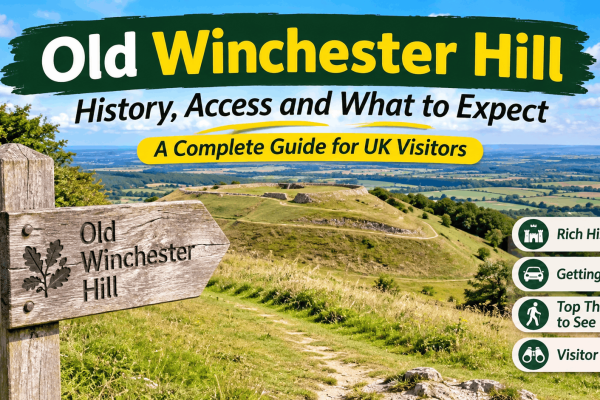
Haytor is one of Dartmoor’s most recognisable landmarks, and for good reason. The granite rocks rise sharply from the eastern edge of the moor, offering views that stretch across Devon to the coast on a clear day. It is also one of the easiest tors to reach by car or bus, which makes it a practical starting point for anyone wanting to experience Dartmoor without committing to a full day’s hike. This guide covers where Haytor is, how it came to look the way it does, and what you need to know before you visit.
Where is Haytor Dartmoor?
Haytor, also known as Haytor Rocks or Hay Tor, sits on the south-eastern edge of Dartmoor in Devon. It is about three miles west of Bovey Tracey, just off the B3387 . The nearest postcode for satnav purposes is TQ13 9XT, which takes you to the lower car park beside the National Park Visitor Centre .
The tor itself reaches 457 metres (1,499 feet) above sea level, which is why the views are so good. On a clear day you can see the South Devon coast, the Teign Estuary, and the rolling countryside between Exeter and Totnes . Haytor is arguably Dartmoor’s most famous landmark, and it is certainly one of the most visited .
For anyone coming from further afield, the nearest railway stations are Newton Abbot and Exeter. From there, bus connections are possible but infrequent. The Haytor Hoppa is a seasonal bus service that runs on summer Saturdays, stopping right outside the Visitor Centre and calling at Widecombe-in-the-Moor, Houndtor, and Becky Falls . It is useful for sightseeing or for walkers who want to do a one-way route.
A Brief History
The granite that forms Haytor is around 280 million years old, but human activity in the area goes back over 4,000 years. The landscape around the tor contains the remains of prehistoric round houses, field boundaries, and burial cairns . It is a place where you can see several layers of history in a short walk.
The name itself has shifted over time. Old records list forms such as Idetordoune in 1566 and Itterdown in 1789. “Haytor” is a relatively recent version, probably a corruption of the older name . In the 19th century, steps were cut into the rock to help visitors reach the summit, and a metal handrail was fixed in place. Not everyone approved. In 1851 a Dr Croker complained about the steps being cut “to enable the enervated and pinguedinous scions of humanity of this wonderful nineteenth century to gain the summit” . The handrail was removed in the 1960s after it rusted, though the stumps of the uprights are still embedded in the rock .
The 19th century also brought industry. Quarries on the northern slopes of Haytor Down were worked intermittently between 1820 and 1919 . The granite was transported by the Haytor Granite Tramway, a remarkable piece of engineering built from granite itself, running down to the Stover Canal and then to Teignmouth . Much of the granite went to London. It was used in the construction of London Bridge, which opened in 1831 and was later moved to Lake Havasu City in Arizona . The last granite quarried here, in 1919, was used for the Exeter war memorial .
In 1953, Haytor was used as a filming location for Knights of the Round Table, starring Robert Taylor and Ava Gardner. An elaborate castle set was built between the two main rock piles, and jousting was staged on the moor . The whole of Haytor Down was sold to the Dartmoor National Park Authority in 1974 .
How to Visit
The main access point is the Haytor National Park Visitor Centre on the B3387. There are three car parks: lower, middle, and upper. Parking in all Haytor car parks is now covered by the same ticket, so you can pay once and move between them . Charging hours are 10am to 6pm, Monday to Sunday. As of the current Dartmoor National Park charges, all vehicles pay £3.40 for up to three hours or £5.60 for over three hours. Blue Badge holders pay £3.40 for the day. Minibuses and coaches pay £11.20 . Motorbikes park for free .
Payment can be made via the RingGo app or at the machines, which now take card payments only . The lower car park has two electric vehicle charging points .
If you are arriving by public transport, the options are limited. Buses from Newton Abbot and Bovey Tracey are infrequent . The Haytor Hoppa on summer Saturdays is the most reliable option for a car-free visit, but it is seasonal, so check the Dartmoor National Park travel information before planning around it.
What to See and Do
The obvious first thing to do is climb Haytor Rocks. The views from the top are the main attraction, and the climb itself is short but steep in places. The tor has a distinctive “avenue” shape, with two main outcrops and a gap between them where softer rock has eroded away . The western outcrop has a pronounced overhang at its base, a rock shelter formed by finer-grained granite eroding faster than the rock above .
The National Park Visitor Centre at the lower car park is worth a stop. It has leaflets for walks around Haytor and a booklet about the area’s history . The centre is also the starting point for the Haytor audio walk, which you can download before you visit .
For industrial heritage, walk to Haytor Quarry and the Granite Tramway. The tramway is a fascinating thing to see: it was built out of the granite it was designed to carry, and much of it remains visible today . You can follow the route of the tramway as part of the Templer Way, an 18-mile trail from Haytor down to Teignmouth . You do not have to walk the whole thing, of course. Even a short section gives you a sense of how the stone was moved.
Wildlife is another draw. The area is known for rare butterflies and birds, and cuckoos can be heard in spring . In late May, Holwell Lawn, nearby, is covered in bluebells . If you are visiting with children, the combination of rocks to scramble on, wide open space, and the occasional ice cream van in the lower car park makes for a straightforward family outing.
For something more strenuous, Houndtor is a few miles to the west. The rocks there have their own legend, involving a pack of hounds turned to stone by a witch, and some say they inspired Conan Doyle’s The Hound of the Baskervilles . Below Hound Tor are the remains of a medieval village, which is worth exploring if you have the time and energy .
Practical Tips for Visitors
Check the weather before you go. Haytor is exposed, and conditions can change quickly. The open moor offers little shelter, and mist can reduce visibility fast. Even a short walk to the tor from the car park feels different in wind and rain.
Wear proper footwear. The path from the car park to the rocks is uneven, and the granite itself can be slippery when wet. Trainers are fine in dry weather, but boots are better if you plan to explore further afield.
Bring cash or a card for parking, and check the current charges. The car park machines take cards only, so if you prefer cash you will need the RingGo app . The charges are not extortionate, but they are not free either.
Keep dogs under control. Dartmoor is grazing land, and livestock, including ponies, sheep, and cattle, may be present. The National Park asks visitors to give livestock space and keep dogs on leads where required.
Do not rely on public transport without checking. The Haytor Hoppa is useful but seasonal. Buses from Newton Abbot and Bovey Tracey are infrequent . If you are coming by bus, plan your return journey before you set out.
Frequently Asked Questions
Where is Haytor Dartmoor?
Haytor is on the south-eastern edge of Dartmoor in Devon, about three miles west of Bovey Tracey on the B3387. The postcode for the main car park and Visitor Centre is TQ13 9XT . It is signposted from Bovey Tracey and is straightforward to reach by car.
What is the history of Haytor Dartmoor?
Haytor’s human history goes back over 4,000 years, with prehistoric remains visible on the down. In the 19th century, granite quarries operated on the northern slopes between 1820 and 1919. The granite was carried by the Haytor Granite Tramway to the Stover Canal and then to Teignmouth, and some of it was used in London Bridge . The area was sold to the Dartmoor National Park Authority in 1974 .
How much is parking at Haytor Dartmoor?
Parking is charged from 10am to 6pm daily. All vehicles pay £3.40 for up to three hours or £5.60 for over three hours. Blue Badge holders pay £3.40 for the day, and minibuses and coaches pay £11.20. Motorbikes park free . The same ticket covers all Haytor car parks, so you can move between them without paying again.
What is the best time to visit Haytor Dartmoor?
Late spring and early summer are popular for good reason: the weather is usually milder, the days are long, and Holwell Lawn is covered in bluebells in late May . Summer weekends can be busy, especially around midday. If you want quieter conditions, go early in the morning or outside school holidays. Winter visits are possible but require more caution because of weather and shorter daylight hours.
Can you climb Haytor Rocks?
Yes. The path to the top is short but steep in places, and the granite can be slippery in wet weather. The views from the summit are the reward, stretching across Dartmoor and toward the South Devon coast . There is no charge to climb the rocks themselves; you only pay for parking.
How do I get to Haytor by public transport?
Public transport to Haytor is limited. The Haytor Hoppa runs on summer Saturdays, stopping at the Visitor Centre and connecting with Widecombe-in-the-Moor, Houndtor, and Becky Falls . Buses from Newton Abbot and Bovey Tracey are infrequent . If you are relying on public transport, check the Dartmoor National Park travel information for current timetables before you travel.