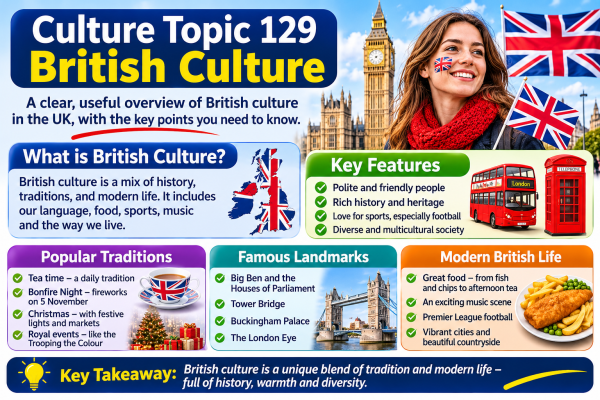
Culture Topic 128 is one of those subjects that sits quietly in the background of British life until you need to think about it properly. This guide sets out the key points in plain English, explains why the topic matters for UK readers, and covers the practical considerations worth knowing. It assumes no prior knowledge and is written for anyone who wants a straightforward overview rather than a lecture.
Overview
Culture Topic 128 belongs to the Culture & Knowledge category, which means it is an accessible explainer rather than a specialist study. It is the sort of subject that comes up in conversation, in the media, or in the background of everyday decisions.
The first thing to understand is that the topic is broader than it first appears. What most people mean when they refer to it is a specific example or a familiar aspect, but the underlying ideas connect to a wider set of questions. Getting the basics clear makes the rest easier to follow.
It is also worth saying at the outset that this is not a subject that requires expert knowledge to understand at a useful level. A clear grasp of the main points and a bit of curiosity will take you a long way. Where deeper specialist knowledge genuinely matters, this guide flags it rather than pretending otherwise.
Key points to know
The core of the topic can be broken down into a few points that matter most for a general reader. These are the things that come up again and again, and understanding them saves confusion.
The first key point is about context. Culture Topic 128 did not appear from nowhere. It has a background, a set of influences, and a reason it is discussed the way it is. Knowing that background turns a confusing subject into a fairly logical one.
The second point is about variety. There is rarely a single correct interpretation. In most cultural and general knowledge subjects, there are several reasonable perspectives, and the most useful approach is to understand a few of them rather than settle on the first one you encounter.
The third point is about change over time. Cultural subjects are not fixed. Ideas, language, and common understanding shift, so any specific claim should be treated as a snapshot rather than a permanent truth. Checking current sources before relying on a detail is always sensible.
The fourth point is about the limits of a general overview. A short guide can give you the shape of a subject and the vocabulary to explore it further, but it cannot cover everything. Recognising where to go next is part of using the topic well.
Practical considerations
When it comes to actually using this information, a few practical considerations make a real difference. These are the things that help a general reader get more out of the subject.
Start by being clear about why the topic interests you. Are you reading for general knowledge, for a conversation, or for a practical decision? A clear purpose sharpens your thinking and helps you judge which parts of the subject matter most.
Next, consider your sources. Cultural topics attract a lot of casual claims, and not all of them are reliable. Books, established reference works, museums, and reputable publications are safer starting points than social media summaries. A little care about where information comes from prevents a lot of confusion.
Then think about the people you might discuss it with. Cultural subjects are often shared subjects, and talking them through with friends, family, or colleagues is one of the best ways to test your understanding. A quick conversation can reveal gaps in your knowledge that reading alone would not.
Finally, keep a note of what you learn. This sounds dull, but it is genuinely useful. Jotting down a name, a date, or a source makes it much easier to follow up later and to explain your reasoning to someone else.
UK context
For UK readers, there are a few specific angles worth noting. British culture and general knowledge have their own rhythms, references, and habits, and the topic shows up in particular ways here.
The first is the role of public institutions. In the UK, much of the background to this topic involves bodies such as the BBC, the British Library, national museums, and local libraries. These organisations vary in what they offer, but they are generally good, free starting points for anyone who wants to learn more.
The second is the regional pattern. Cultural life in the UK is not uniform. England, Scotland, Wales, and Northern Ireland each have their own traditions, institutions, and reference points. If you are reading about a subject online, check that the framing matches where you live or where the subject originates.
The third is the language. Cultural topics in the UK often come with their own vocabulary, and some terms carry assumptions that are not obvious to everyone. If a word or phrase is unclear, it is worth looking it up rather than guessing. Plain English guides and glossaries are a useful starting point.
The fourth is the variation in access. What is free and available in one part of the UK may not be in another. Libraries, museums, and archives differ in their opening hours and collections. Checking locally before you travel or plan is always sensible.
Further reading
If you want to go deeper into this topic, there are a few reliable places to start. These are practical, public sources rather than specialist publications, and they are written for a general audience.
The first is the BBC, which covers a wide range of cultural and general knowledge subjects in accessible language and is kept up to date. It is not always the most detailed source, but it is a good place to check the basics and to find out what is being discussed.
The second is the British Library and national museums, which offer free online resources, exhibitions, and reading lists on many cultural subjects. Their websites are clear and well organised, and they cover the kind of background that a general reader needs.
The third is your local library. For anything that varies by area, the library is the most reliable starting point. It may not be the most glamorous option, but it will tell you what is actually available where you live.
Finally, for topics that involve money, health, or legal matters, it is worth speaking to a qualified adviser rather than relying on general guides. This article is an overview, not a substitute for specialist advice, and where the stakes are higher, the right move is to ask someone who deals with the subject professionally.
Frequently Asked Questions
What is Culture Topic 128?
Culture Topic 128 is an accessible subject covered in the Culture & Knowledge category. It is the kind of topic that comes up in general conversation and the media, and it can be understood without prior specialist knowledge.
Why does Culture Topic 128 matter?
It matters because it connects to ordinary decisions, conversations, and understanding of British life. Understanding the basics helps you make sense of what you read and hear, and it makes it easier to discuss the subject with confidence.
What should UK readers know about Culture Topic 128?
UK readers should be aware that the subject can vary by nation and by local institution. England, Scotland, Wales, and Northern Ireland do not always share the same references or resources, and public bodies differ in what they offer. Checking current, local information is always sensible.
Where can I find more information on Culture Topic 128?
The BBC, the British Library, and national museums are good starting points for accessible information. Your local library is the most reliable source for anything that varies by area. For matters involving money, health, or legal issues, a qualified adviser is the right person to ask.